
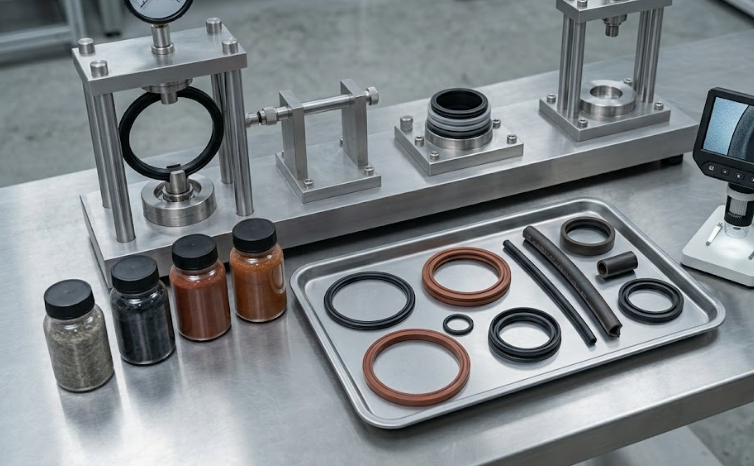
Selecting the right automotive rubber seal material is one of the most important decisions during vehicle component development. While rubber seals may appear to be simple parts, they perform critical functions that directly influence vehicle durability, passenger comfort, safety, and long-term reliability.
A poorly selected rubber compound can lead to premature cracking, fluid leakage, excessive noise, or expensive warranty claims, even when the component itself is manufactured within dimensional specifications.
For engineers and purchasing teams, choosing between an EPDM rubber seal, NBR rubber seal, silicone rubber seal, or FKM seal involves much more than comparing material datasheets.
Every elastomer offers unique advantages and limitations, and the best choice depends on the actual operating environment rather than a single performance property.
One lesson that becomes clear after working on multiple automotive programs is that rubber material selection should never begin with the question, "Which material is the best?" Instead, the better question is, "What conditions will this seal experience throughout its service life?" Answering that question often prevents costly design revisions after tooling has already been completed.
Why Material Selection Matters in Automotive Rubber Seals
Modern vehicles contain hundreds of sealing components that protect systems from water, dust, chemicals, vibration, and changing temperatures. These components are found throughout the vehicle, from door weatherstrips and window channels to engine gaskets, fuel system seals, cooling systems, and electrical connectors.
Each application exposes the rubber seal to different environmental conditions. A rubber seal on car doors spends years exposed to sunlight, rain, ozone, and repeated compression whenever the door is opened or closed. Meanwhile, a fuel injector seal operates in an entirely different environment where resistance to gasoline, engine oil, and elevated temperatures becomes the primary concern.
Because of these differences, there is no universal automotive rubber seal material that works for every application. Selecting an inappropriate compound may still allow the part to pass initial inspection, but problems often appear after months or years of real-world service.
From an engineering perspective, the objective is not simply to produce a seal that fits. The goal is to produce a seal that maintains consistent performance throughout the vehicle's expected service life while remaining economically manufacturable.
Understanding the Operating Environment Before Selecting a Rubber Material
Material selection should always begin with a complete understanding of the application. Experienced rubber engineers typically evaluate several operating conditions before recommending a specific elastomer.
Temperature is usually one of the first considerations. Components located near the engine or turbocharger may experience continuous temperatures well above those encountered by exterior weatherstrips. A material that performs well around a vehicle door may deteriorate rapidly when exposed to prolonged engine heat.
Chemical exposure is equally important. Some seals must resist gasoline, diesel fuel, lubricating oils, hydraulic fluids, transmission fluids, or coolants. Others may never contact these substances but instead require excellent resistance to water and road contaminants. Selecting a material without considering chemical compatibility often leads to swelling, softening, or loss of sealing performance.
Environmental exposure also deserves careful attention. Exterior rubber components spend years under ultraviolet radiation, ozone, rain, humidity, and seasonal temperature changes. In many cases, weather resistance becomes more critical than tensile strength or hardness.
Compression set is another property that should not be overlooked. Most automotive seals remain compressed for extended periods. If the material cannot recover after long-term compression, sealing force gradually decreases, increasing the risk of leaks, wind noise, or water intrusion.
One situation frequently encountered during product development is that customers specify hardness and color while providing little information about the operating environment. Although hardness is an important specification, it rarely provides enough information to determine the most suitable rubber compound. Understanding the actual service conditions almost always leads to better material recommendations.
Comparing Common Automotive Rubber Seal Materials
Although many elastomers are available for automotive manufacturing, four materials are among the most commonly used for sealing applications.
EPDM Rubber Seal
An EPDM rubber seal is widely recognized for its excellent resistance to weathering, ozone, ultraviolet radiation, and water. These characteristics make EPDM one of the preferred materials for exterior automotive sealing applications.
Door weatherstrips, window seals, trunk seals, roof seals, and sunroof components commonly use EPDM because they remain exposed to outdoor environments throughout the vehicle's life. The material also maintains flexibility across a broad temperature range and demonstrates excellent resistance to aging.
However, EPDM has a significant limitation. It does not perform well when exposed to petroleum-based oils or fuels. Using EPDM in applications involving engine oil or gasoline can result in swelling and deterioration, making it unsuitable for many under-hood sealing applications.
NBR Rubber Seal
An NBR rubber seal, also known as nitrile rubber, is specifically valued for its excellent resistance to petroleum oils and fuels. This makes it a common choice for fuel system components, hydraulic seals, O-rings, and oil-resistant gaskets.
Compared with EPDM, NBR performs significantly better when exposed to lubricants and automotive fluids. However, its resistance to ozone and long-term outdoor weathering is considerably lower. For exterior applications exposed to sunlight, NBR generally requires additional protection or may not be the most appropriate choice.
Balancing oil resistance with environmental durability is often one of the key considerations during material selection
.
Silicone Rubber Seal
A silicone rubber seal is frequently selected when wide operating temperature capability is required. Silicone maintains flexibility at extremely low temperatures while also performing well at elevated temperatures where many conventional elastomers begin to degrade.
Its excellent resistance to aging also makes silicone suitable for applications requiring long-term stability. However, engineers should recognize that silicone generally exhibits lower tear resistance and abrasion resistance than several other elastomers. For dynamic sealing applications involving repeated mechanical wear, silicone may require careful evaluation before selection.
FKM Seal
An FKM seal is typically chosen for demanding automotive environments involving aggressive chemicals and high operating temperatures. FKM offers excellent resistance to fuels, oils, many automotive chemicals, and continuous heat, making it a preferred material for fuel injection systems, turbocharger components, and high-performance engine applications.
The primary trade-off is cost. FKM compounds are generally more expensive than EPDM or NBR, so they are usually reserved for applications where their superior chemical and thermal performance justifies the investment.
Rather than viewing FKM as a premium replacement for every seal, experienced engineers consider it a specialized solution for particularly demanding service conditions.
Matching the Material to the Application
The best rubber seal for cars depends entirely on where the component will be installed.
For a rubber seal on car doors, EPDM is generally the preferred choice because of its outstanding resistance to sunlight, rain, ozone, and temperature fluctuations. These environmental conditions represent the primary challenges faced by exterior weatherstrips.
Engine compartment seals often require materials capable of resisting oils and elevated temperatures. Depending on the application, NBR or FKM may provide better long-term performance.
Cooling system seals frequently benefit from EPDM because of its excellent resistance to hot water and coolant. Silicone may also be selected where higher operating temperatures or improved flexibility are required.
Fuel system components typically demand superior resistance to hydrocarbons. In these applications, NBR and FKM are generally more appropriate than EPDM.
This application-based approach illustrates why selecting an automotive rubber seal material should always begin with understanding the service environment rather than choosing the most familiar elastomer.
Common Material Selection Mistakes
One misconception often encountered during sourcing is the assumption that all black rubber materials perform similarly. In reality, two seals with identical hardness, color, and appearance may behave very differently once installed because their compound formulations have been engineered for entirely different environments.
Another common mistake is selecting a material based primarily on purchase price. While reducing material costs may appear attractive during quotation, premature seal failure can result in warranty expenses, production interruptions, and customer dissatisfaction that far exceed the initial savings.
Successful automotive programs typically evaluate total lifecycle performance rather than focusing only on the initial component cost.
Rubber Compound Development Is Equally Important
Choosing EPDM, NBR, silicone, or FKM is only the beginning of material selection. The final performance of a rubber seal also depends heavily on compound formulation.
Different curing systems, fillers, reinforcing agents, plasticizers, and processing additives can significantly influence compression set, tensile strength, elongation, aging resistance, and manufacturability. Two EPDM compounds supplied by different manufacturers may demonstrate noticeably different performance despite sharing the same base polymer.
For this reason, OEM manufacturers often develop customized rubber compounds that satisfy specific application requirements instead of relying solely on standard commercial grades.
Technical Consultation & RFQ Support for Rubber Compound and Product Development
For OEM manufacturers, product designers, and engineering teams developing rubber components, selecting the appropriate rubber material and compound formulation during the early design stage is a critical factor that influences product performance, service life, application reliability, and overall production cost.
Through technical discussions during product development, critical factors such as mechanical property requirements, operating temperature, chemical exposure, environmental conditions, sealing performance, and target service life can be evaluated comprehensively before tooling design and mass production begin.
At Banshu Rubber Indonesia, we support rubber product development through a structured engineering approach. Our services include evaluating material requirements based on actual application conditions, recommending suitable elastomer types and compound formulations, conducting Design for Manufacturability (DFM) reviews for molded rubber parts, assessing potential product failure risks such as compression set, cracking, swelling, and deformation during service, and optimizing the combination of material selection, product design, tooling, and manufacturing process parameters.
This engineering-driven approach helps ensure that the selected rubber material and compound not only satisfy technical specifications but can also be manufactured consistently, deliver stable field performance, and achieve long-term cost efficiency.
Engineering and purchasing teams are welcome to submit 2D or 3D drawings, technical specifications, or product samples for technical evaluation. We also support the Request for Quotation (RFQ) process by providing recommendations on material selection, rubber compound development strategies, tooling design, and mass production readiness.
If you would like technical consultation or wish to discuss your requirements for rubber compounds, rubber mixing, or custom molded rubber parts, please contact the engineering team at Banshu Rubber Indonesia. We will be pleased to evaluate your application and recommend a manufacturing solution that aligns with your product requirements and performance objectives.